Tuesday, March 6, 2012

Why the CS Report is only somewhat right and very wrong.

Credit Suisse has released a report entitled "Is the commodity supercycle behind us?" by Dong Tao. This report has a couple of important points, but misses several key items. But what does the report say?

The following is from the summary:
"We believe the golden age of infrastructure investment is behind
us now. The golden age of housing boom is behind us now. The
golden age of export is behind us now. The golden age of policy
stimulus is behind us now.
● But, one more leg of urbanisation is expected. Further
acceleration in policy housing is likely.
● Still, trend growth in the next decade is projected at 7–8% versus
10.3% in the past decade. Growth engines will shift from exports
and infrastructure to consumption, which means that it will take
less commodity consumption for each unit of GDP."

First, we need to see that commodities are not all identical. One key difference between commodities is 'capital commodities' vs 'consumption commodities'. Capital commodities are not used up and continue to exist for many years. For example, copper wire is produced and used for many years. It then can be melted down and re-used. It is a 'Capital commodity'. Other commodities like this are Gold, silver, aluminum, iron and to some extent steel. The use of the commodity continues for many years. In contrast 'consumption commodities' are consumed. Oil is consumed and cannot be 'resused' or used more than once. You go to the store in a car and gasoline is consumed and can not be 'resused' or used for many years. Likewise the soft commodities like soybeans are consumed.

In this article, the author makes no distinction between capital commodities and consumption commodities. Look at the following chart and notice the products along the bottom:
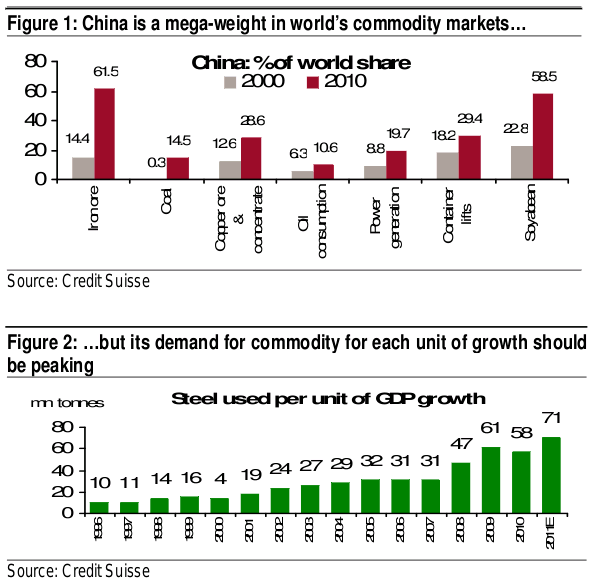
Do you see that copper is not the same as soybeans? If the statement about the 'age of infrastructure are true, copper demand might change. But why would soybean demand decrease because infrastructure investment decreases? The argument just does not hold. In fact, I would argue just the opposite. As the age of infrastructure is over, the age of consumption starts. In the age of consumption, consumption commodities will be in MORE demand than in the age of infrastructure. Soybeans and oil are will be in MORE demand than before.

Second, the law of growth is important. Let's use a simple example. If you start out at 100 on an measure of economic activity and that economic activity requires 10 units of 'commodities'. If you grow by 10%, that would increase your commodity demand by 1 (assuming the same ratio). Now assume the economy grows by 10% for 10 years. At the end of ten years, the index is at 235. Now assume the growth rate falls to 7%. The INCREASE in commodity demand, assuming a constant ratio is still 1.65 and is MORE than the INCREASE in demand for most years. The TOTAL demand for commodities is now 25.2, up from 10 in the first year. Do you see that the growth of the economy means that ZERO growth, does not decrease the 25.2 demand for commodities, but only decreases the 'growth rate of demand'. That is totally different than decreasing demand.

Thus, we have the Chinese economy about the change gears (if the CS author is correct about that), but that has vastly different implications for different commodities. As people achieve basic stability and economic prosperity, they start to have different demands. For example, the demand for jewelry and other high fashion will increase. Likewise the demand for more complex meals will increase. This will change the type of commodities that are demanded. Steel demand will decrease. But gasoline demand may skyrocket as people begin to buy cars and take vacations. Why work 80 hour weeks if you can't ever take a vacation? The demand for airtravel will increase and the demand for jet fuel will increase.

Thus a changing Chinese economy will have massive impacts on the price of commodities, but it will not all be bad. Some commodities will see skyrocketing demand, while others may see demand stay level.

Friday, March 2, 2012

Still Bearish on Nat Gas

The natural gas situation has changed somewhat. The production has started to fall, but the demand is still very very weak from the warm winter. We will have large amounts of natgas in storage and this will limit prices till next January. Only a crazy cold spell will decrease this overhang and now that the sun is higher in the sky, the demand for natgas falls every day all other things being constant. Thus, the price of natgas will be low all summer. At some point the price of natgas will rise, but any increase that is enough to get producer's attention, will increase rig counts. That will increase production and bring prices back down.

The only question is what are the prices that will clear the market this summer and what can the price rise to before rig counts start up again.

Tuesday, January 3, 2012

Bearish on Natural Gas

The ng market is over-supplied. Until demand increases, the market (ung) is not a good investment. Having said that, the cure for low prices is low prices. The demand for nat gas will continue to increase. For example, visiting my brother in Evansville Ind, I saw near a major road "Natural Gas Filling Station: Price $1.38 a gallon". When a natgas filling station is open and in a good location, maybe the tide is turning. While usage by vehicles is small and not growing near fast enough, it has the capacity to skyrocket.

But even more important, power generation usage will grow. This category will determine the price of natgas more than any other. In all previous posts, I have argued "weather, weather and weather" determined the price of natgas. No longer. While weather has the ability to temporary change the price of natgas, it no longer can deliver the large change in demand that is needed for prices to go back to $4 (much less $10!). Quite simply the basic demand for natgas from power generation has to increase for natgas to increase in price.
To see that the following chart shows the weather related demand for residential and commercial:

Notice the base (summer months) demand is relatively flat over the past 10 years. Likewise while the top tips are slightly higher, not by much. Quite simply residential and commercial demand can be seen as only slightly increasing.
So without major changes in how heating in residential and commercial buildings are generated, we will depend on industrial and power generation for increased demand.

Will this happen? For electric generation, it is happening:


Notice in the chart above, the baseload natgas demand has increased. This is very important, because one natgas power plant can consume alot of natural gas. It takes a ton of buildings to change heat sources to equal the demand from one natgas power plant. So one (the only?) source of increased demand is power plants.

What do we have on the regulatory front? We have the EPA just issuing new rules on emissions that make coal plants much more costly. They will shut down a significant number of coal plants and change the fuel to natgas. This transition is the only one that will quickly change the demand for natgas.

On the other side of the equation, we need to be careful not to expect too much from supply changes. The point being if the price were to rise from some temporary factors (a cold winter), the supply could increase very fast. The number of potential natgas wells is huge, if the price rises back to $5. Thus, until the baseline demand is significantly higher, natgas will not sustain a price above $4.

What about LNG? Here is the problem: the length of time it takes to permit, plan and build natgas export plants is years.... 5 years? We will not see ANY exports before 2014. Maybe 2016. Yes the possibility of significant demand for natgas from LNG exports exists, but we cannot build the plants before 2015. So between now and then power generation demand is the only source of increased demand that can really impact the price of natgas.

Conclusion: You can predict the natgas price by the size and number of natural gas power plants. Watch the trend and if the number of plants increases enough the demand for natgas may rise and increase price. Otherwise, any temporary increase in price will bring large amounts of supply to crush the price increase.

Friday, December 16, 2011

The State of the American Economy.

Given everything the state of the American Economy is getting better and better. But you object that unemployment is high and the investment climate is horrid! The US government is horrid! We don't have a leader and Congress is ......! All that is true. But the actual economy is slowing mending. The most recent economic data support the idea the economy is actually growing.

A second key element is the state of the banks:

Small Banks Delinquent Loans

Large Banks Delinquent Loans.


So the banks are slowing dealing with the problem loans. They are slowing working through the junk and cleaning up their balance sheets. Contrast this with both Europe and China. In both of these have not even started cleaning up their banks. The European banks still don't even know which loans are junk and which are good. The Chinese banks are going to have property loans that will be delinquent. The result is both Europe and China are far behind the US. While the Chinese economy is still growing, there are signs it will slow and have the first recession in a long time. The net impact of all of these factors is the US stock market will at some time be a great place to invest.

Bur what about Europe? Isn't there is a significant risk that Europe implodes (explodes?). The banking system in Europe is slowing grinding to a halt and this will cause a severe recession for Europe. What's worse the banking system and the governments of Europe are intertwined in a very complex and dangerous way. If a government (think Greece) goes bankrupt, it will force ALL the banks in that country to go bankrupt. The banks have significant government debt on their balance sheets and cannot survive if the government goes down. But if all the banks in the country are bankrupt, then they don't make loans. When banks don't make loans, the average business cannot get loans and lays people off. This decreases taxes and forces the government to cut back. But if the government becomes more bankrupt (losses increase), then the banking sector is hit a second time. They make even less loans and cause the economy to contract further. OUCH!
A long and very sad depression can result.

One piece of good news is that the Ted Spread is falling. This is an important measure of the banking system.

This graph shows the slow drop in the risk premium for lending to banks. The system is slowing getting better.
But without a question, the raw economics of Europe is uncertain. The fact that Governments HAVE to pull back and spend less means a drag on the economy. The importance of the Government sector in Europe is huge and if it truly cuts expenditures, the economy will falter. So European banks are not lending and the Governments are cutting back. The situation is dire.

So we have two very contradictory trends: One: the US economy is ready for a dramatic rise. Two: Europe may fall into a depression. What will happen? The direction is likely to come from a 'tipping point'. In other words, some event will happen that in normal times would be minor, but it will force either a depression in Europe or a strong rebound in the US Economy.

One event that would cause dramatic changes is Iran. The Israelis are clearly unhappy with the nuclear developments in Iran. Will they act? Will a military strike occur? This would be a tipping point.

Are there any other options? The muddle through option is always possible. In other words, nothing much happens we go up a little and then down a little. We don't really go anywhere. But with the dramatic and powerful forces at work, I suspect a 'tipping point' event is far more likely.

Thursday, December 1, 2011

Main Street or Wall Street?

The basic "Main Street" economy is starting to recover. Retail sales are strong; Apartment rentals are strong; Purchasing Manager's index is strong. The overall impact is the base economy in the US is slowly recovering. But.....

"Wall Street" and the banking sector is weak. Europe and the large banks have had a difficult time recovering from the recession. One of the key questions is which is going to win out? Will the banking sector/Europe drag Main street down to a 2nd recession? Or will the strength of Main Street drag the banking sector out of recession? Which will win?

Tuesday, November 15, 2011

Wednesday, August 24, 2011

First draft of Powerpoint

For 10 days, I returned to a remote corner of the Dominican Republic and Haiti.
This trip was with the Foundation for Peace, an NGO that a former member of my church has setup. Our group was very diverse and included people from 4 countries (US, Kenya, DR and Haiti). We included local people for both their translation skills and their physical efforts to help our projects. Below is a power point summary of the trip:
http://www.iow.com/dr-hati2011.ppt