Last year the United States duly elected Donald Trump as President. While many events happened last year, the results of the election were not legally contested. The results stand. Unfortunately, the press seems to think they are more "important' than any group of citizens. After all they have the 'correct' view of all the candidates and Donald Trump 'cannot' be President.
The idea that the Press and only the Press can select the President is the definition of a Pressocracy. The press wants us to believe they and they alone can determine the qualities and qualifications of the next President. This is not a democratic idea, but an elitist and classist view of the world. A democratic view is the people rule, even if they make a stupid choice.
I for one, do not wish to live in a Pressocracy and will do everything in my legal right to prevent such an event.
Monday, May 22, 2017


Saturday, March 18, 2017
Middelbury and the Trump Science Budget
"On March 2nd, Several hundred protesters at Middlebury College shouted down guest speaker Charles Murray, a social scientist who wrote a book discussing racial differences in intelligence. The college moved the March 2 talk to another location and live streamed it, but it was drowned out by protesters.
The college says a group of demonstrators angrily confronted Murray, a professor and a college administrator as they were leaving campus. It says someone pulled the professor's hair and she was treated for a neck injury and a concussion." (From an AP story WFSB website).
From CNN on March 16th:
"President Donald Trump's proposed budget, "America First: A Budget Blueprint to Make America Great Again" (PDF), paints a dramatic picture for the American science and medical communities that is facing huge potential budget cuts."
These two events are related. The simple fact is many in academic profession have been on a mission to eliminate any conservative voices. And there is a consequence of that movement when conservatives win an election: there will be a cut in science spending.
If you want government spending on an issue over the decades, you have to be prepared to have a number of different Presidents and different political viewpoints in charge of the Budget. If you only cater and demand one political view, then when an opposition candidate wins, you will face budget cuts. When you demand extreme political vetting for any science candidate and any science being done, you will face the consequences when the opposite political party wins. And at some point over the decades they will win. Thus, the extreme politicization of American Science will cause large decreases in science budgets.
Some may not agree that conservatives are being targeted, but look at key conservate views on the issue:
Thomas Sowell writes the following:
"Many people seem shocked at the recent savagery of a mob of students at Middlebury College, who rioted to prevent Charles Murray from addressing a student group who had invited him to speak. They also inflicted injuries requiring hospitalization on a woman from the faculty who was with him.
Where have all these shocked people been all these years? What happened at Middlebury College has been happening for decades, all across the country, from Berkeley to Harvard. Moreover, even critics of the Middlebury College rioters betray some of the same irresponsible mindset as that of the young rioters."
Even an editorial at the New York Times on ensuring a diverse (eg including conservative views on college campuses ) was trashed by many progressives. Thus, conservatives believe they are being discriminated against by science and most colleges.
During the coming year, the Congress will vote on the Budget. How many conservatives will defend Science spending when they feel they have been attacked and discriminated against by the University experience?
Sunday, March 5, 2017
US Oil Production increasing because of Alaska and Off-Shore.
US Onshore Production is still FALLING.
Contrary to many reports, the actual US onshore production fell throughout 2016. Many have argued that the increased rig counts increased US oil production. But that is false. What is increasing US oil production is offshore legacy drilling and Alaska. Taking out these two sources of oil the US oil production is still falling:

The narrative in the oil market is false. US Shale production takes some time to respond to price and will not be the savor of oil production. The next chart shows EOG Resources oil production over the past years. Notice it is flat. One of the best shale fracking companies has flat oil production. This is not just a simple one off, but a key company if US oil produciton is going to increase.

The oil markets may be underestimating the future US oil production.
Friday, September 11, 2015
The 2016 Presidential Election
As of today, the following is my take on the candidates:
A) HRC: She is in real trouble. The reason is she cannot lie. Her handling of the email problem has been more than worse: it could kill her candidacy. Why? Because two important things people look for in a President: 1) Can the candidate understand me and do I understand the candidate?
2) Why does the candidate want the job?
In both of these she fails on the email problem. First, everyone who works understands the idea of having a 'work' email and 'home' email. The fact that she did not want to be 'bothered' by two emails, shows an elitism that separates her from the 'average Jane' (or Joe). She is just not like an 'average' person, but is 'above' all that. That is one way to kill a presidential campaign. Second, her lies were so obvious to be insulting. You are an idiot and I can lie straight to your face and you don't know it.
People don't expect a candidate to tell the truth 100% of the time. But if they do lie, they at least want them to be good at it. She fails on all accounts.
A second major problem is "the vision thing". Recall Pres. Bush (the first one) had a 'vision problem'. He had no idea why he was going to be President. HRC has "to be the first woman", but that's it.
Yes she has a ton of position papers, but why does she want to be President?
Result: Even with insane advantages, she may not get the Dem Nomination. (50-50) Even lower chance of beating a Reb.
B) Trump: 1) Everyone has seen Trump enough and has some idea of who he is. They understand what he is selling. The point is many are tried of 'weak' candidates and want someone to go to Washington and say: "Your Fired". The idea of a strong willed candidate appeals to a wide range of people. Thus, Trump's support is not ideological, but practical. With a few issues he has suggested he understands the basic person's situation.
2) Why? "Make America Great Again" The slogan is BY FAR the best of any candidate. He knows how to read the public and make a strong selling point. This is not to be underestimated because most of the other candidates have no idea how to do this.
The Reb nomination is currently his to loose. 25%
C) Bern: 1) Is not known enough by the general public, but a firebrand always has a place in American Politics. People can understand it and he does have many advantages.
2) A theme is both harder and easier for a firebrand.
Result: 35% chance of Dem. Nomination
D) Carson: 1) Like Bern a firebrand. 2) A theme really needs to be voiced that is more concise than his current talk. He needs a Trump advisor to get a witty slogan.
Result: 35%
E) Biden: 1) Son. that's a huge story and one that can propel him to a win
2) Much harder but if he can get a good one line reason: could be a winner.
Result: If he runs 50%, but 50-50 he runs
F) Reb Field:
It's really hard to figure the candidates out this far out and this many. I suspect one will make a stab at the two front-runers.
Result: 45% chance an 'established' candidate gets it.
If forced to pick today (this may change), I would guess a Biden-Carson race, but this has a low probability of happening.
Wednesday, February 25, 2015
Why oil prices will not 'Calm down', but may be headed for extreme volatility.
Saudi Arabia's Oil Minister Ali al-Naimi said:
"I don't like to talk about oil because we want calmness," Naimi said when questioned by reporters.
"Why do you want to bring up the prices issue? Leave the prices alone." [Reuters]
As long as OPEC will not change production based on market trends, the idea that oil prices should remain calm are false. History shows that oil prices are very volatile. The reason is easy for economists to explain. The demand for oil is very inelastic and the supply is also very inelastic. The result is small changes to either the demand or supply can force extreme short-term price responses. These extreme short-term fluctuations in oil prices can be seen in the long term chart below:
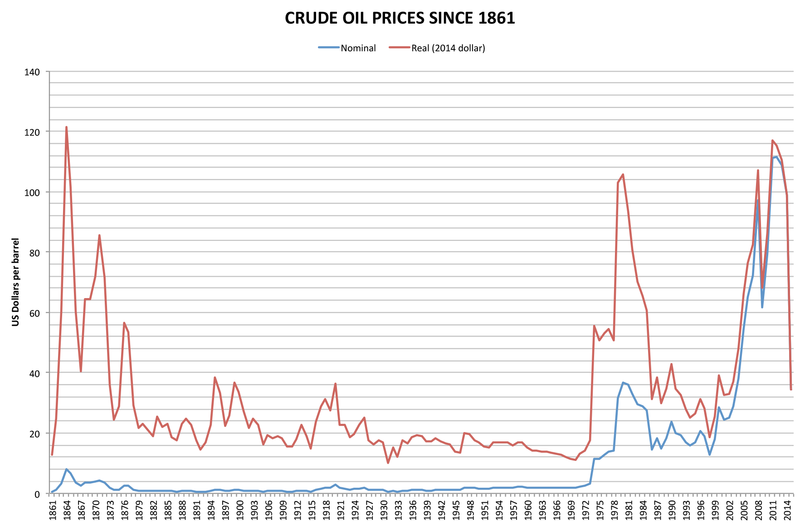
In fact oil prices were so volatile that the Texas Railroad Commission had a goal of price stabilization. "Before OPEC took center stage, one state agency in Texas was widely believed to set oil prices for the world." [The Texas Railroad Commission by William Childs].
If OPEC truly retreats from price setting, then almost by definition, oil price volatility will increase. Without a 'guiding hand' not just a small increase in oil price volatility, but volatility will skyrocket. For example, a range of $20-$200 every year is not out of the question. Why?
As stated earlier, the elasticity of BOTH supply and demand is very low. It takes a HUGE price swing to change either. For example, to cut supply it takes a price below the marginal cost of production. But with oil wells, almost all the cost is sunk. Most of the cost is to drill the well, not produce the oil. Thus, once the well is drilled it takes an absurd price to stop production (like $20). On the other hand, consumption is also inelastic. For example, to get people to trade in their electric car for a truck will require a huge change in price of gasoline. To change the consumption of gasoline, you need a huge change that wakes people up and occurs over time. Thus to get a 10% increase in gasoline sold, you need 50% or more change in price for many weeks if not months. Thus, for either supply or demand to change significantly, you need a HUGE change in price.
But that creates a problem over time. If the price falls to $20, demand jumps 6 months later. At the same time as wells deplete and no new wells are drilled, the amount supplied also falls. To get production increasing, you then need a price above $100. So the price starts to skyrocket. After $150, demand starts to decrease but supply surges and then you have too much oil. Now to get supply to decrease and demand to increase back to $20. Without OPEC changing production, the price will have to change dramatically down and dramatically up. The volatility of oil prices is headed to insane levels, if OPEC has truly stopped it's price setting.
The conclusion is either OPEC starts moderating price by changing production or the price of oil will become very very very volatile.
Sunday, February 1, 2015
Wednesday, January 7, 2015
Econ 101 for Oil
Many in the oil market seem to have forgotten Econ 101. To bring everyone on the same page, below is meant to be a refresher in case you forgot, never learned or just didn't care.
First, a demand curve goes downward from a high price and a low quantity to a low price and a high quantity. For example, at $15 a beer, you tend not to consume very many beers. But at 15 cents a beer, well......
Supply curves are just the opposite. They go from a low price and low quantity to a high price and high quantity. So if you are making hot dogs at a food truck the price and the quantity would be:
If you can only sell hot dogs for 50 cents, you might just stay home and sell zero.
But if you can sell hot dogs for $10, you are going to want to sell a zillion.
If all of a sudden Costco has a sale on hot dogs and you can buy them for 10 cents each, then at every price you want to sell more hot dogs than before.
For oil markets, the fracking/horiz/new technologies has meant that for every price, there is more oil.
Thus in the short-run (weeks), the following chart shows the impact:


But over time, things change. For example, at a low price most people will not buy a BIG car, fly more and in general use more oil. It takes time to schedule a vacation and buying a car is not done very week. But over several years, people will respond to low prices by increasing the quantity demanded at every price point. This is reflected in the charts below:
Notice how a price of $50 is required to clear the markets in the short-run, but a price of $90 is required in the long-run. This basic difference is a reason commodity markets can be very volatile.
Prices can go up by 100% or down by 50% in a very short time. To clear a commodity market in the short-run, prices have to go crazy.
This is why farmers want various programs to stabilize the price of corn (or other products). In oil, OPEC has preformed this role by increasing or decreasing production to stabilize the price.
But when OPEC decides not to stabilize the price, the impact can be more severe than if OPEC did not exist. Many people planned on OPEC to provide stable prices and thus planned their actions on this assumption. But when OPEC decides NOT to decrease supplies to stabilize price, the price needs to change more than normal and will stay lower longer than normal to cut production and stimulate demand.
Last, but not least, is the question: How long is the short-run vs long-run? When does the demand and supply curves change to less elastic curves? This has been a question on the Investor Village Board BRY for the past week. Some very good posters have argued that the supply and demand response would be fast, while others argue the supply response will take years. How fast is the response? Anyone who says they know for sure are wrong (even if in this case they lucky happen to be right).
Many factors go into the response of consumers and producers to changes in price.
1) The degree of price change. Many books and articles have been written about the 'tipping point' where at some price consumers and producers 'wake up' and suddenly change behavior. Thus, many who use straight line response models, are shocked at sudden and strong movements by consumers and producers.
2) Other economic factors. For example, if the consumers just got a pay raise, they might behave differently than if they just got fired. Thus a strengthening economy (the US currently) is a far different response than a declining economy.
3) Technological changes. Producers may be experiencing such a great change in technology that the costs are falling even more than anyone expects.
4) Political concerns. At a tipping point, both consumers and producers may be influenced by other factors, such as politics, geography and personal biases. These are near impossible to predict and can make fools of many pundits.
Given all these factors any estimation of oil prices in 2015, such as the price as of June 30 or Dec 31 is more of a guess than a scientific estimate. My personal view is the price could fall to some very low amount, but will rebound to $70s by June and $100 by Dec. But this is a wild ass guess and any price between $20 and $150 is possible.
Wednesday, June 4, 2014
Household Balance Sheets and the Economy
Everyone is wondering why the economy has been sluggish in the past couple of years. Two charts below show the dramatic changes in the household balance sheets:


First, Liabilities as a percent of Household wealth has been falling like a rock. From an all time high in 2009, they gone back to 2001 levels. This dramatic decline in household debt HAS to be recessonary. The amount of money in the system will fall and the demand for goods will fall.
Second, a measure of the cash-flow ability to pay debts has also fallen. If you take total household liabilities divided by disposable income, you can get a quick and dirty view of the consumer's ability to pay debt. Again this measure has fallen significantly as consumer's paid down debt. But this measure has fallen far less than the first. Clearly asset prices are rising much faster than incomes.
With the consumer rebalancing their assets and liabilities, the economy has suffered greatly. When will this end? When will the balance sheets be rebalanced?
First, demographics are a factor. With the baby boomers hitting retirement, the demand for debt must fall. The 70 year old has a much different 'desired' balance sheet than a 50 year old. To get to that 'desired' balance sheet requires liquidating debt (or not taking on debt as assets and income grow).
Second, the next generation has high eduction debt. This high debt must be repaid and will be a huge drag on the economy for the next few years. Most eduction debt has a relative short repayment period- 5 years vs a mortgage debt of 30 years.
Third, even with the decline in debt usage, debt is high compared to the 1980s. The consumer balance sheet still has huge amounts of debt and especially when you look at income to service the debt. As a result it is hard to predict when the rebalancing of the consumer portfolio will be finished.
Conclusion: We have been in a slow growth mire for several years and unless incomes rise the amount of debt will continue to constrain the economy.
Friday, August 10, 2012
Nat Gas Production
Natural Gas Production


As a result, the decrease in natural gas production still has not occurred. Yes the production is off the highs, but any measure of trends, the recent declines are well within the long-term upward trend lines. You can quibble with the exact drawing of the lines, but it is clear the natgas production has not fallen below the long-term upward trend lines.
As a result, the people who argue natgas production is headed down are not right----yet. Clearly production is not heading up as it was late last year. But a slowdown in an upward trend is not a decrease in production.
Monday, May 14, 2012
Greece and Gold
Right now the price of gold has not responded to the Greek Crisis. It may not for many months, but at some point the reality of the situation is going to make gold skyrocket. Why?
1) The European voters in Greece, France and even Germany have clearly told the politicians that austerity is not an acceptable course of action. In two major elections this past weekend, we saw an overhaul in management in two European countries, France and Greece.
German results were also a blow against austerity: "DUESSELDORF, Germany — Voters in Germany's most populous state dealt a decisive blow to Chancellor Angela Merkel's Christian Democratic Union on Sunday, preliminary results show, a potentially ominous preview of things to come for the chancellor in next year's federal elections" The voters in every country have made it very clear they do not like austerity but they want spending.
2) How are they going to pay for these programs? Every country in the EU is already spending more than they take in revenue. The only way to pay for these programs is to print more money. Quite simply there is no alternative. Either the governments cut back expenses AND raise taxes or they print more money. They WILL print more money.
3) Right now we are in a deep recession. In addition, we are in a panic (or more accurately a flight to safety). People want their investment to be safe. As a result US Treasuries are priced at the highest (lowest yield) in 50 years. People are worried and want their money to be safe. But in a highly leveraged system as the world is in today, this need for safety will cause the economy to stay very weak. Only when people are confident in the future, will business investment, jobs and the economy pick up. Instead of recognizing this and acting the current administration took the advice of pure Keynesian economists. While the government does need to act, HOW it acts IS important. Giving $500 million to Solendra to waste will not strengthen the economy, but instead will lead to further weakness. FDR was right that Fear is the problem.
One solution to get people to move out of treasuries is to scare them with inflation. The Fed is in part trying to calm markets and make long-term investments 'cheap', but something rings false. People are still sacred and not making normal investments. The hypothesis is the FED will take more and more extreme measures to force investments out of treasuries and into the 'real' economy.
At tipping point will happen at some point and people will realize that the US Dollar, Euro and other currencies can and are being printed in unlimited amounts. Once a crisis occurs in a currency, it takes years (decades?) for a country to recover. The only question is when will we move from deflation to inflation? To that question, I have no answer. But with each QE program, the time comes closer.
Once we have a tipping point from deflation to inflation, gold prices will skyrocket. But when???
Monday, April 9, 2012
The Jobless Recovery
No matter how the government calculates the unemployment rate, the employment rate is still very very low for a recovery.
The simple fact is employment is not growing like it should in a recovery. Why?
1) Anytime you have a financial panic, the growth will be slower. This has been well documented by several studies and needs no further comment.
2) Specific actions by the Obama Administration has lead to lower employment. The health care act and government regulations in general have can lead to increased cost of employing people. Especially if the regulations deal with firing or cutting employment, firms will respond by decreasing the hiring of employees.
3) Technology has increased the productivity of employees which is a long term good for the economy, but a short term drag.
If this were true, then once economic growth increases above two percent, employment growth should pick up. If employees are very productive, it will make sense to hire them, so they increase profits. Anytime a person is more productive and the firm can increase it's sales, it will make sense to hire more people. Increases in productivity are GOOD for employment.
But as the chart below shows, employment increases just have not happened. Clearly something very basic is wrong.

Wednesday, April 4, 2012
Which Direction?
There are two possible extreme courses:
1) The economy grows and QE3 is not needed
2) The economy falters and QE3 is needed.
What the market seems to like is the second alternative, while I like the first alternative. What has happened every time QE3 is 'more off the table' is the market falls. But this is very shortsighted. Bernanke has made it very very very clear: The main reason for the Great Depression going longer than expected was a too quick increase in interest rates. The Fed WILL keep rates low for an extended period of time. Once economic growth returns in a reasonable rate, then and only then will the Fed take the foot off the pedal.
But the markets seem to react to every Fed meeting with uncertainty and confusion. The idea that the economy grows should be good news for the stock market. But instead, economic growth is being met with disbelief. The market is so pessimistic that the idea of sustained economic growth is discounted to the extreme. This negativity is seen through out American society today.
Even if the economy muddles through and provides low economic growth, the Fed will continue very aggressive expansionary actions. Only strong economic growth will force the Fed to act to reign in already occurring inflation.
Tuesday, March 6, 2012
Why the CS Report is only somewhat right and very wrong.
Credit Suisse has released a report entitled "Is the commodity supercycle behind us?" by Dong Tao. This report has a couple of important points, but misses several key items. But what does the report say?
The following is from the summary:
"We believe the golden age of infrastructure investment is behind
us now. The golden age of housing boom is behind us now. The
golden age of export is behind us now. The golden age of policy
stimulus is behind us now.
● But, one more leg of urbanisation is expected. Further
acceleration in policy housing is likely.
● Still, trend growth in the next decade is projected at 7–8% versus
10.3% in the past decade. Growth engines will shift from exports
and infrastructure to consumption, which means that it will take
less commodity consumption for each unit of GDP."
First, we need to see that commodities are not all identical. One key difference between commodities is 'capital commodities' vs 'consumption commodities'. Capital commodities are not used up and continue to exist for many years. For example, copper wire is produced and used for many years. It then can be melted down and re-used. It is a 'Capital commodity'. Other commodities like this are Gold, silver, aluminum, iron and to some extent steel. The use of the commodity continues for many years. In contrast 'consumption commodities' are consumed. Oil is consumed and cannot be 'resused' or used more than once. You go to the store in a car and gasoline is consumed and can not be 'resused' or used for many years. Likewise the soft commodities like soybeans are consumed.
In this article, the author makes no distinction between capital commodities and consumption commodities. Look at the following chart and notice the products along the bottom:

Do you see that copper is not the same as soybeans? If the statement about the 'age of infrastructure are true, copper demand might change. But why would soybean demand decrease because infrastructure investment decreases? The argument just does not hold. In fact, I would argue just the opposite. As the age of infrastructure is over, the age of consumption starts. In the age of consumption, consumption commodities will be in MORE demand than in the age of infrastructure. Soybeans and oil are will be in MORE demand than before.
Second, the law of growth is important. Let's use a simple example. If you start out at 100 on an measure of economic activity and that economic activity requires 10 units of 'commodities'. If you grow by 10%, that would increase your commodity demand by 1 (assuming the same ratio). Now assume the economy grows by 10% for 10 years. At the end of ten years, the index is at 235. Now assume the growth rate falls to 7%. The INCREASE in commodity demand, assuming a constant ratio is still 1.65 and is MORE than the INCREASE in demand for most years. The TOTAL demand for commodities is now 25.2, up from 10 in the first year. Do you see that the growth of the economy means that ZERO growth, does not decrease the 25.2 demand for commodities, but only decreases the 'growth rate of demand'. That is totally different than decreasing demand.
Thus, we have the Chinese economy about the change gears (if the CS author is correct about that), but that has vastly different implications for different commodities. As people achieve basic stability and economic prosperity, they start to have different demands. For example, the demand for jewelry and other high fashion will increase. Likewise the demand for more complex meals will increase. This will change the type of commodities that are demanded. Steel demand will decrease. But gasoline demand may skyrocket as people begin to buy cars and take vacations. Why work 80 hour weeks if you can't ever take a vacation? The demand for airtravel will increase and the demand for jet fuel will increase.
Thus a changing Chinese economy will have massive impacts on the price of commodities, but it will not all be bad. Some commodities will see skyrocketing demand, while others may see demand stay level.
The following is from the summary:
"We believe the golden age of infrastructure investment is behind
us now. The golden age of housing boom is behind us now. The
golden age of export is behind us now. The golden age of policy
stimulus is behind us now.
● But, one more leg of urbanisation is expected. Further
acceleration in policy housing is likely.
● Still, trend growth in the next decade is projected at 7–8% versus
10.3% in the past decade. Growth engines will shift from exports
and infrastructure to consumption, which means that it will take
less commodity consumption for each unit of GDP."
First, we need to see that commodities are not all identical. One key difference between commodities is 'capital commodities' vs 'consumption commodities'. Capital commodities are not used up and continue to exist for many years. For example, copper wire is produced and used for many years. It then can be melted down and re-used. It is a 'Capital commodity'. Other commodities like this are Gold, silver, aluminum, iron and to some extent steel. The use of the commodity continues for many years. In contrast 'consumption commodities' are consumed. Oil is consumed and cannot be 'resused' or used more than once. You go to the store in a car and gasoline is consumed and can not be 'resused' or used for many years. Likewise the soft commodities like soybeans are consumed.
In this article, the author makes no distinction between capital commodities and consumption commodities. Look at the following chart and notice the products along the bottom:
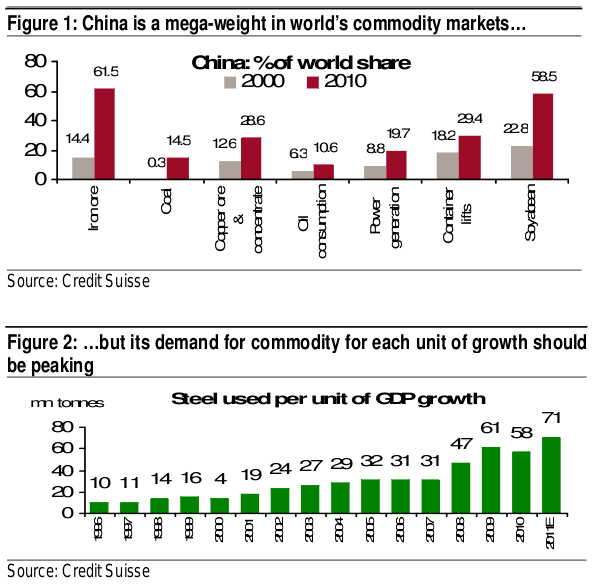
Do you see that copper is not the same as soybeans? If the statement about the 'age of infrastructure are true, copper demand might change. But why would soybean demand decrease because infrastructure investment decreases? The argument just does not hold. In fact, I would argue just the opposite. As the age of infrastructure is over, the age of consumption starts. In the age of consumption, consumption commodities will be in MORE demand than in the age of infrastructure. Soybeans and oil are will be in MORE demand than before.
Second, the law of growth is important. Let's use a simple example. If you start out at 100 on an measure of economic activity and that economic activity requires 10 units of 'commodities'. If you grow by 10%, that would increase your commodity demand by 1 (assuming the same ratio). Now assume the economy grows by 10% for 10 years. At the end of ten years, the index is at 235. Now assume the growth rate falls to 7%. The INCREASE in commodity demand, assuming a constant ratio is still 1.65 and is MORE than the INCREASE in demand for most years. The TOTAL demand for commodities is now 25.2, up from 10 in the first year. Do you see that the growth of the economy means that ZERO growth, does not decrease the 25.2 demand for commodities, but only decreases the 'growth rate of demand'. That is totally different than decreasing demand.
Thus, we have the Chinese economy about the change gears (if the CS author is correct about that), but that has vastly different implications for different commodities. As people achieve basic stability and economic prosperity, they start to have different demands. For example, the demand for jewelry and other high fashion will increase. Likewise the demand for more complex meals will increase. This will change the type of commodities that are demanded. Steel demand will decrease. But gasoline demand may skyrocket as people begin to buy cars and take vacations. Why work 80 hour weeks if you can't ever take a vacation? The demand for airtravel will increase and the demand for jet fuel will increase.
Thus a changing Chinese economy will have massive impacts on the price of commodities, but it will not all be bad. Some commodities will see skyrocketing demand, while others may see demand stay level.
Friday, March 2, 2012
Still Bearish on Nat Gas
The natural gas situation has changed somewhat. The production has started to fall, but the demand is still very very weak from the warm winter. We will have large amounts of natgas in storage and this will limit prices till next January. Only a crazy cold spell will decrease this overhang and now that the sun is higher in the sky, the demand for natgas falls every day all other things being constant. Thus, the price of natgas will be low all summer. At some point the price of natgas will rise, but any increase that is enough to get producer's attention, will increase rig counts. That will increase production and bring prices back down.
The only question is what are the prices that will clear the market this summer and what can the price rise to before rig counts start up again.
The only question is what are the prices that will clear the market this summer and what can the price rise to before rig counts start up again.
Tuesday, January 3, 2012
Bearish on Natural Gas
The ng market is over-supplied. Until demand increases, the market (ung) is not a good investment. Having said that, the cure for low prices is low prices. The demand for nat gas will continue to increase. For example, visiting my brother in Evansville Ind, I saw near a major road "Natural Gas Filling Station: Price $1.38 a gallon". When a natgas filling station is open and in a good location, maybe the tide is turning. While usage by vehicles is small and not growing near fast enough, it has the capacity to skyrocket.
But even more important, power generation usage will grow. This category will determine the price of natgas more than any other. In all previous posts, I have argued "weather, weather and weather" determined the price of natgas. No longer. While weather has the ability to temporary change the price of natgas, it no longer can deliver the large change in demand that is needed for prices to go back to $4 (much less $10!). Quite simply the basic demand for natgas from power generation has to increase for natgas to increase in price.
To see that the following chart shows the weather related demand for residential and commercial:

Notice the base (summer months) demand is relatively flat over the past 10 years. Likewise while the top tips are slightly higher, not by much. Quite simply residential and commercial demand can be seen as only slightly increasing.
So without major changes in how heating in residential and commercial buildings are generated, we will depend on industrial and power generation for increased demand.
Will this happen? For electric generation, it is happening:

Notice in the chart above, the baseload natgas demand has increased. This is very important, because one natgas power plant can consume alot of natural gas. It takes a ton of buildings to change heat sources to equal the demand from one natgas power plant. So one (the only?) source of increased demand is power plants.
What do we have on the regulatory front? We have the EPA just issuing new rules on emissions that make coal plants much more costly. They will shut down a significant number of coal plants and change the fuel to natgas. This transition is the only one that will quickly change the demand for natgas.
On the other side of the equation, we need to be careful not to expect too much from supply changes. The point being if the price were to rise from some temporary factors (a cold winter), the supply could increase very fast. The number of potential natgas wells is huge, if the price rises back to $5. Thus, until the baseline demand is significantly higher, natgas will not sustain a price above $4.
What about LNG? Here is the problem: the length of time it takes to permit, plan and build natgas export plants is years.... 5 years? We will not see ANY exports before 2014. Maybe 2016. Yes the possibility of significant demand for natgas from LNG exports exists, but we cannot build the plants before 2015. So between now and then power generation demand is the only source of increased demand that can really impact the price of natgas.
Conclusion: You can predict the natgas price by the size and number of natural gas power plants. Watch the trend and if the number of plants increases enough the demand for natgas may rise and increase price. Otherwise, any temporary increase in price will bring large amounts of supply to crush the price increase.
Friday, December 16, 2011
The State of the American Economy.
Given everything the state of the American Economy is getting better and better. But you object that unemployment is high and the investment climate is horrid! The US government is horrid! We don't have a leader and Congress is ......! All that is true. But the actual economy is slowing mending. The most recent economic data support the idea the economy is actually growing.
A second key element is the state of the banks:
Small Banks Delinquent Loans

Large Banks Delinquent Loans.

So the banks are slowing dealing with the problem loans. They are slowing working through the junk and cleaning up their balance sheets. Contrast this with both Europe and China. In both of these have not even started cleaning up their banks. The European banks still don't even know which loans are junk and which are good. The Chinese banks are going to have property loans that will be delinquent. The result is both Europe and China are far behind the US. While the Chinese economy is still growing, there are signs it will slow and have the first recession in a long time. The net impact of all of these factors is the US stock market will at some time be a great place to invest.
Bur what about Europe? Isn't there is a significant risk that Europe implodes (explodes?). The banking system in Europe is slowing grinding to a halt and this will cause a severe recession for Europe. What's worse the banking system and the governments of Europe are intertwined in a very complex and dangerous way. If a government (think Greece) goes bankrupt, it will force ALL the banks in that country to go bankrupt. The banks have significant government debt on their balance sheets and cannot survive if the government goes down. But if all the banks in the country are bankrupt, then they don't make loans. When banks don't make loans, the average business cannot get loans and lays people off. This decreases taxes and forces the government to cut back. But if the government becomes more bankrupt (losses increase), then the banking sector is hit a second time. They make even less loans and cause the economy to contract further. OUCH!
A long and very sad depression can result.
One piece of good news is that the Ted Spread is falling. This is an important measure of the banking system.

This graph shows the slow drop in the risk premium for lending to banks. The system is slowing getting better.
But without a question, the raw economics of Europe is uncertain. The fact that Governments HAVE to pull back and spend less means a drag on the economy. The importance of the Government sector in Europe is huge and if it truly cuts expenditures, the economy will falter. So European banks are not lending and the Governments are cutting back. The situation is dire.
So we have two very contradictory trends: One: the US economy is ready for a dramatic rise. Two: Europe may fall into a depression. What will happen? The direction is likely to come from a 'tipping point'. In other words, some event will happen that in normal times would be minor, but it will force either a depression in Europe or a strong rebound in the US Economy.
One event that would cause dramatic changes is Iran. The Israelis are clearly unhappy with the nuclear developments in Iran. Will they act? Will a military strike occur? This would be a tipping point.
Are there any other options? The muddle through option is always possible. In other words, nothing much happens we go up a little and then down a little. We don't really go anywhere. But with the dramatic and powerful forces at work, I suspect a 'tipping point' event is far more likely.
A second key element is the state of the banks:
Small Banks Delinquent Loans

Large Banks Delinquent Loans.

So the banks are slowing dealing with the problem loans. They are slowing working through the junk and cleaning up their balance sheets. Contrast this with both Europe and China. In both of these have not even started cleaning up their banks. The European banks still don't even know which loans are junk and which are good. The Chinese banks are going to have property loans that will be delinquent. The result is both Europe and China are far behind the US. While the Chinese economy is still growing, there are signs it will slow and have the first recession in a long time. The net impact of all of these factors is the US stock market will at some time be a great place to invest.
Bur what about Europe? Isn't there is a significant risk that Europe implodes (explodes?). The banking system in Europe is slowing grinding to a halt and this will cause a severe recession for Europe. What's worse the banking system and the governments of Europe are intertwined in a very complex and dangerous way. If a government (think Greece) goes bankrupt, it will force ALL the banks in that country to go bankrupt. The banks have significant government debt on their balance sheets and cannot survive if the government goes down. But if all the banks in the country are bankrupt, then they don't make loans. When banks don't make loans, the average business cannot get loans and lays people off. This decreases taxes and forces the government to cut back. But if the government becomes more bankrupt (losses increase), then the banking sector is hit a second time. They make even less loans and cause the economy to contract further. OUCH!
A long and very sad depression can result.
One piece of good news is that the Ted Spread is falling. This is an important measure of the banking system.
This graph shows the slow drop in the risk premium for lending to banks. The system is slowing getting better.
But without a question, the raw economics of Europe is uncertain. The fact that Governments HAVE to pull back and spend less means a drag on the economy. The importance of the Government sector in Europe is huge and if it truly cuts expenditures, the economy will falter. So European banks are not lending and the Governments are cutting back. The situation is dire.
So we have two very contradictory trends: One: the US economy is ready for a dramatic rise. Two: Europe may fall into a depression. What will happen? The direction is likely to come from a 'tipping point'. In other words, some event will happen that in normal times would be minor, but it will force either a depression in Europe or a strong rebound in the US Economy.
One event that would cause dramatic changes is Iran. The Israelis are clearly unhappy with the nuclear developments in Iran. Will they act? Will a military strike occur? This would be a tipping point.
Are there any other options? The muddle through option is always possible. In other words, nothing much happens we go up a little and then down a little. We don't really go anywhere. But with the dramatic and powerful forces at work, I suspect a 'tipping point' event is far more likely.
Thursday, December 1, 2011
Main Street or Wall Street?
The basic "Main Street" economy is starting to recover. Retail sales are strong; Apartment rentals are strong; Purchasing Manager's index is strong. The overall impact is the base economy in the US is slowly recovering. But.....
"Wall Street" and the banking sector is weak. Europe and the large banks have had a difficult time recovering from the recession. One of the key questions is which is going to win out? Will the banking sector/Europe drag Main street down to a 2nd recession? Or will the strength of Main Street drag the banking sector out of recession? Which will win?
"Wall Street" and the banking sector is weak. Europe and the large banks have had a difficult time recovering from the recession. One of the key questions is which is going to win out? Will the banking sector/Europe drag Main street down to a 2nd recession? Or will the strength of Main Street drag the banking sector out of recession? Which will win?
Tuesday, November 15, 2011

Wednesday, August 24, 2011
First draft of Powerpoint
For 10 days, I returned to a remote corner of the Dominican Republic and Haiti.
This trip was with the Foundation for Peace, an NGO that a former member of my church has setup. Our group was very diverse and included people from 4 countries (US, Kenya, DR and Haiti). We included local people for both their translation skills and their physical efforts to help our projects. Below is a power point summary of the trip:
http://www.iow.com/dr-hati2011.ppt
Monday, August 8, 2011
Why is gold doing so well?
If you look at the following chart, we see gold has outperformed the S&P500 for the past two years.
If you look at longer time frames, gold continues to outperform all other asset classes.
Why?

1) The simple fact is a credit economy is dependent on inflation. The Federal Reserve does not have a zero inflation target, but a 2% inflation target. That means each year, without considering any other factor, gold should rise 2%. This base increase in the price of gold year after year is important.
2) WIth the large amounts of credit and the complex financial transactions, the financial system has wrung out every efficiency from the system. The amount of gains from trade in financial transactions has slowed and may be negative as some trades that don't work are reversed.
3) A financial meltdown is always more severe and longer lasting than normal recessions. When you add a system that depends on complex financial transactions to survive, the world has become a scarier place. The problems are greater than the systems ability to solve them. The net result is a rush to safety. You just cannot devalue all the currencies at the same time. The race to the bottom of the currency world will propel gold to new highs.
4) You have a huge wealth transfer from the West to the East. The problem is the wealth has all be in US Treasures. How to pay off the Chinese for all the goods we bought? Inflate the dollar and pay them back with lower priced dollars. It is a tried and true method of paying your debts when you control the printing presses.
5) Because of the new wealth of the East, their central banks are uninvested in gold. They don't have the reserves of gold that were bought by Europe and the US in the 1800 and early 1900s. As a result, China, Russia, and a host of countries are increasing their central banks reserves of gold.
Future of gold? Until the US has a balanced budget, I cannot see the price of gold falling for a significant time. The best, easiest, and only possible political solution to the massive government debt is inflation. Until the debt is brought under control and the Fed is not FORCED to print money, gold will be one of the best investments for US citizens.
If you look at longer time frames, gold continues to outperform all other asset classes.
Why?
1) The simple fact is a credit economy is dependent on inflation. The Federal Reserve does not have a zero inflation target, but a 2% inflation target. That means each year, without considering any other factor, gold should rise 2%. This base increase in the price of gold year after year is important.
2) WIth the large amounts of credit and the complex financial transactions, the financial system has wrung out every efficiency from the system. The amount of gains from trade in financial transactions has slowed and may be negative as some trades that don't work are reversed.
3) A financial meltdown is always more severe and longer lasting than normal recessions. When you add a system that depends on complex financial transactions to survive, the world has become a scarier place. The problems are greater than the systems ability to solve them. The net result is a rush to safety. You just cannot devalue all the currencies at the same time. The race to the bottom of the currency world will propel gold to new highs.
4) You have a huge wealth transfer from the West to the East. The problem is the wealth has all be in US Treasures. How to pay off the Chinese for all the goods we bought? Inflate the dollar and pay them back with lower priced dollars. It is a tried and true method of paying your debts when you control the printing presses.
5) Because of the new wealth of the East, their central banks are uninvested in gold. They don't have the reserves of gold that were bought by Europe and the US in the 1800 and early 1900s. As a result, China, Russia, and a host of countries are increasing their central banks reserves of gold.
Future of gold? Until the US has a balanced budget, I cannot see the price of gold falling for a significant time. The best, easiest, and only possible political solution to the massive government debt is inflation. Until the debt is brought under control and the Fed is not FORCED to print money, gold will be one of the best investments for US citizens.
Subscribe to:
Posts (Atom)